 Artblocks
 minting pricing, access and settlement choices
Artblocks minting uses release-specific sale contracts to set an artwork's price and determine which wallets can purchase a token. Fixed-price releases accept purchases while supply remains. Ranked auctions allocate artworks through bidding, while Dutch auctions reduce their purchase price over time. Allowlists and token gates add eligibility requirements to selected releases. The minter, meaning the smart contract that handles a sale, determines the applicable pricing and settlement rules. Ethereum gas adds a separate cost. Comparing these choices requires distinguishing the amount committed initially from the final artwork price, along with the conditions that let a wallet participate.
On this page
Pricing and access at a glance
Fixed-price and auction minters differ in when they determine the artwork price and how they allocate available tokens. An approved wallet may qualify for a sale without holding a reservation, while an auction bidder may commit funds before receiving an NFT.
| Minter configuration | Pricing, access and settlement rules |
|---|---|
| Fixed price in ETH | Fixed unit price; purchases depend on remaining sale allocation. |
| Fixed price with an allowlist | Approved wallets only; optional per-wallet mint limits. |
| Fixed price for token holders | Required artwork held at purchase; available supply still limits access. |
| Exponential Dutch auction with settlement | Configured price-decay half-life; eligible excess payments are claimable. |
| Exponential Dutch auction without settlement | Configured price-decay half-life; each buyer pays the purchase-time price. |
| Linear Dutch auction without settlement | Configured start and end times; no later price equalization. |
| Ranked Auction Minter (RAM) | Configured bidding window; bids use 512 preset price levels. |
Holder-gated Dutch auctions also exist, so a declining price does not establish open access. The assigned contract determines the combination available for a release.
The suite also includes fixed prices in a configured ERC-20 token and a Minimum Price minter with a render-provider fee.
Curated and Studio describe publishing contexts. Their labels alone do not identify the sale contract or establish a universal mint price.
When does an accepted bid become an NFT?
An accepted RAM bid becomes an NFT only when a later mint creates the token for that bid. A successful fixed-price purchase combines payment and minting in its purchase transaction. Minting associates the artwork with token-specific data and records ownership through the ERC-721 standard.
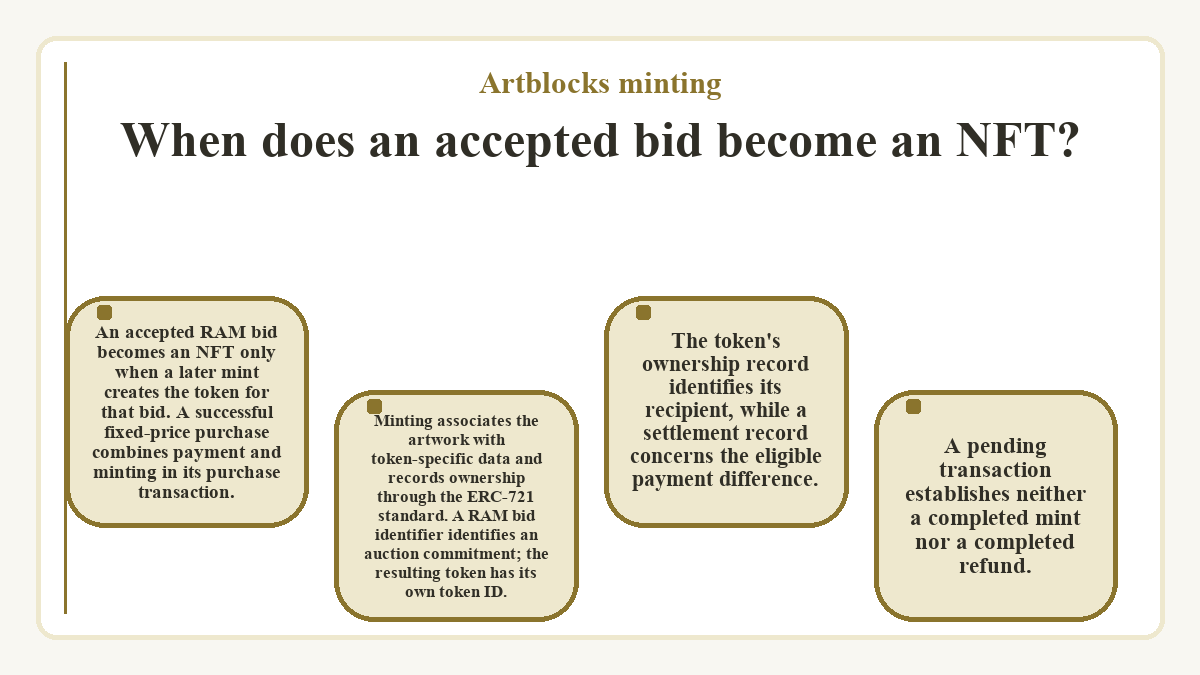
A RAM bid identifier identifies an auction commitment; the resulting token has its own token ID. The token's ownership record identifies its recipient, while a settlement record concerns the eligible payment difference. A pending transaction establishes neither a completed mint nor a completed refund.
Artwork prices and transaction costs
A fixed-price ETH release charges the configured artwork price while its sale allocation remains available. Collectors also need ETH for Ethereum transaction fees, commonly called gas. Network activity changes that fee, so the artwork price alone does not describe the required wallet balance. First-come-first-served allocation also makes transaction confirmation relevant: submitting a purchase while supply remains does not reserve the final piece.
A reverted mint can still consume gas. That expenditure remains separate from any artwork payment or later auction settlement.
Auction participation can spread transaction costs across placing a bid, increasing it and collecting a later claim. The particular contract determines which actions the collector initiates. A shared artwork settlement price therefore does not make each collector's total gas expenditure equal.
Ranked bids and the clearing price
MinterRAMV0 ranks bids against an auction-specific token allocation and settles them after bidding closes.
Bids before the allocation fills
A new bid must meet the configured base price and use an accepted price slot. Spare allocation means that the bidder does not yet need to displace an existing bid. The base price remains a floor even when demand is low. Participants cannot cancel an accepted bid at will.
Competition for occupied allocations
A full auction requires a sufficiently higher bid to displace its lowest qualifying bid. MinterRAMV0 uses a 5% outbid threshold when the displaced bid is at or below 0.5 ETH and 2.5% above that level. The preset slots constrain the accepted amount, so a freely chosen decimal amount may not qualify. The minter's next-bid quote includes the slot rounding required by its outbid test. A displaced bid leaves the auction and receives its bid payment back.
Price after bidding closes
A sold-out MinterRAMV0 auction settles winners at the lowest winning bid. An auction that finishes below its allocation instead uses the configured base price. Settlement returns the difference between a winning bid's payment and the applicable artwork price. Gas remains outside that price adjustment.
Can a late RAM bid change the closing time?
A late RAM bid can move the closing time when the auction enables bid-triggered extensions. For MinterRAMV0, new bids that displace existing bids within the final 5 minutes can maintain a 5-minute bidding buffer. Those bid-triggered extensions have a 60-minute cap beyond the scheduled close, as adjusted by any administrative emergency extension.
Administrative emergency extensions use separate contract powers. The 60-minute limit specifically describes bid-triggered extra time.
Declining prices and Dutch-auction settlement
A Dutch auction lowers its purchase quote over time, with the selected variant determining whether earlier purchases qualify for equalization.
Prices without settlement
An exponential auction uses a configured half-life to control price decay toward its base price. A linear auction follows a configured start and end interval. Without settlement, each collector pays the price applicable to that purchase. Waiting changes the quote only while supply remains available; a lower future quote does not reserve an artwork.
Claimable excess payments
MinterDAExpSettlementV3 lets purchasers claim payments above the contract's current settled price. That price follows the latest purchase price, or the base price after revenue withdrawal following arrival at that floor. At sellout above the base price, the last purchase provides the settlement basis. Purchasers use the contract's reclaim function to recover an eligible difference while retaining their artwork.
Allowlist deadlines and holder eligibility
Restricted releases use the wallet's eligibility at purchase alongside the applicable sale and supply rules.
Pre-approved addresses
An allowlist admits specified wallet addresses before a release. Artists may add a purchase limit for each eligible wallet. Approval does not establish unlimited availability: a deadline or exhausted allocation can close that opportunity. Any later distribution method follows the artist's release configuration, so an earlier allowlist entry does not define the terms of another phase.
Required artwork holdings
A token-holder gate uses ownership of the designated artwork at purchase time. Transferring that qualifying holding beforehand can remove access, even if the wallet qualified earlier. Eligibility depends on the required artwork, so holding an unrelated NFT does not satisfy that particular gate.
Edition caps and sale-phase limits
Project and minter limits can restrict different quantities. On V3 projects, the core contract's maximum invocations define the edition cap; an invocation here means a minted token. A minter can impose a lower cap for its sale phase. An allowlist's per-wallet allowance adds a separate restriction on the eligible address. Reaching a phase cap can therefore stop that minter before the project reaches its total edition size.
Artists can assign different minters to successive phases, including restricted access followed by a public auction. Switching minters requires an explicit configuration change; an expired phase does not automatically activate its replacement. A later phase can therefore change access requirements or pricing without changing the identity of the collection.
Post-auction minting and unallocated works
MinterRAMV0 separates a winner's allocation from the permissions that govern delivery after bidding ends. A sold-out MinterRAMV0 auction can enable a 72-hour period after bidding closes in which only the artist or administrator may mint winning allocations. During that period, their batch-minting path processes higher bids first. If the configuration omits that period, or once it ends, winners can mint their outstanding bids through the open path, subject to sufficient supply. The 72-hour setting governs initiation rights; it does not guarantee delivery within that period.
An undersubscribed auction skips that restricted delivery period. Remaining works can then sell at the configured base price while the contract has supply available beyond outstanding winning allocations. Those purchases create additional tokens from the unsold allocation. They do not replace the artworks owed to existing winners or reopen completed bids. If an operational error leaves too little supply for winning bids, the contract provides a separate refund path.
Participation under the active minter
On V3 projects using the shared Minter Suite, the artist or administrator assigns the active minter. Collectors participate under that release's configured method. An allowlist entry or a budget sufficient for a previous phase does not establish access under a replacement contract. The current method determines the currency, eligibility rules and available sale allocation.
Before committing funds, compare the amount needed now with the price that the contract ultimately charges. A RAM bid may initially tie up more ETH than its clearing price. A non-settlement Dutch purchase fixes its artwork cost at execution. Where a claim remains available, the refundable difference becomes spendable wallet ETH only when the contract returns it.
Things people ask
-
Which RAM bid has priority when two bids have the same value?
- The earlier bid has priority when RAM bids share a price level. Increasing an existing bid resets its priority at the new level, so its original submission time does not preserve an earlier place among equal bids.
-
Can several RAM bids use the same price level?
- RAM permits multiple bids at the same preset price level when each bid satisfies the auction's entry rules. Each bid competes for its own artwork allocation. Sharing a level does not merge bids or increase available supply, and a full auction still enforces its qualifying outbid requirement.
-
Can an ERC-20 balance pay for an ETH-priced release?
- An ERC-20 balance cannot substitute for ETH in an ETH-priced release, even though the Minter Suite also includes separate fixed-price contracts that accept a configured ERC-20 token.
-
Where does a post-auction RAM purchase send the artwork?
- A direct purchase of remaining RAM supply can mint to a specified recipient wallet. This differs from a winning auction bid, whose token goes to the bidding wallet.
-
When can a RAM winner collect an unsettled overpayment?
- MinterRAMV0 allows the original bidder to collect an eligible, unsettled excess payment during its post-auction minting states. A winner can therefore claim the difference before the token arrives, provided the bid satisfies the contract's checks. Collecting settlement does not itself mint the artwork.
-
Are Serial English Auction bids placed before token creation?
- The Serial English Auction minter pre-mints its tokens before their individual auctions begin, so bids concern existing tokens. RAM instead takes bids for allocations that it mints after bidding closes.
-
Will a resale reopen a sold-out primary mint?
- A resale transfers an existing NFT and does not reopen the sold-out primary mint. An owner may offer that token under separate resale terms. Its asking price does not alter the price that applied during the original release or create additional supply for the completed mint.