 Artblocks
 turns artists' code into collectible NFT art
Artblocks turns artists' algorithms into collectible digital artworks, with each new mint creating an NFT tied to a distinct output. The artist defines the rules and controlled variation; the mint supplies the token-specific starting data. A non-fungible token, or NFT, records ownership and provenance on a blockchain. The platform brings together curated releases, artist-led publishing and infrastructure for partner projects. Its catalog includes still images, animation, interactive pieces and audiovisual work.
An artistic system defines a family of works
Generative art begins with an artist designing a system that can produce related works through programmed rules and controlled randomness. The artist determines which properties remain consistent and which can vary. Color palettes, composition and the relationships between elements can all form part of that design. An individual output shows one realization of the system, while the collection reveals more of its range.
Randomness operates inside those artistic decisions. The code establishes the possibilities before any particular token receives its starting data. Understanding a collection therefore involves looking at relationships across its works, including the variation that the artist allows. A single image can show a composition without conveying the full behavior of the underlying program.
Minting connects the code to an individual token
Minting creates a new NFT and associates it with token-specific data that the artist's script uses to generate the work. A hash supplies the seed for the programmed randomness. The project script supplies the rules that interpret that seed.
A deterministic rendering reproduces the same output from the same code and complete set of inputs. A project's animation, interaction or configurable values form part of its programmed behavior. The seed establishes a repeatable starting point within that system.
A renderer brings together the script, token data and required software libraries. A browser runs that assembled program to display the artwork. This distinction separates the stored ingredients from the image or experience that executing the code produces.
The blockchain records ownership and provenance for the collectible token. The script and its inputs determine how the associated artwork appears.
Purchasing an existing token transfers ownership of that token. It does not perform another primary mint or create a fresh edition of the artwork.
Animation and interaction extend the artwork beyond a preview
The catalog includes works whose programmed behavior unfolds through motion, interaction or sound, so a still preview can represent only part of the experience. Animated compositions develop over time. Interactive works respond to inputs that their artists implement, while audiovisual works combine visual output with sound. These features belong to individual collections; the running artwork reveals which behaviors its artist has included.
Curated, Studio and Engine offer distinct publishing paths
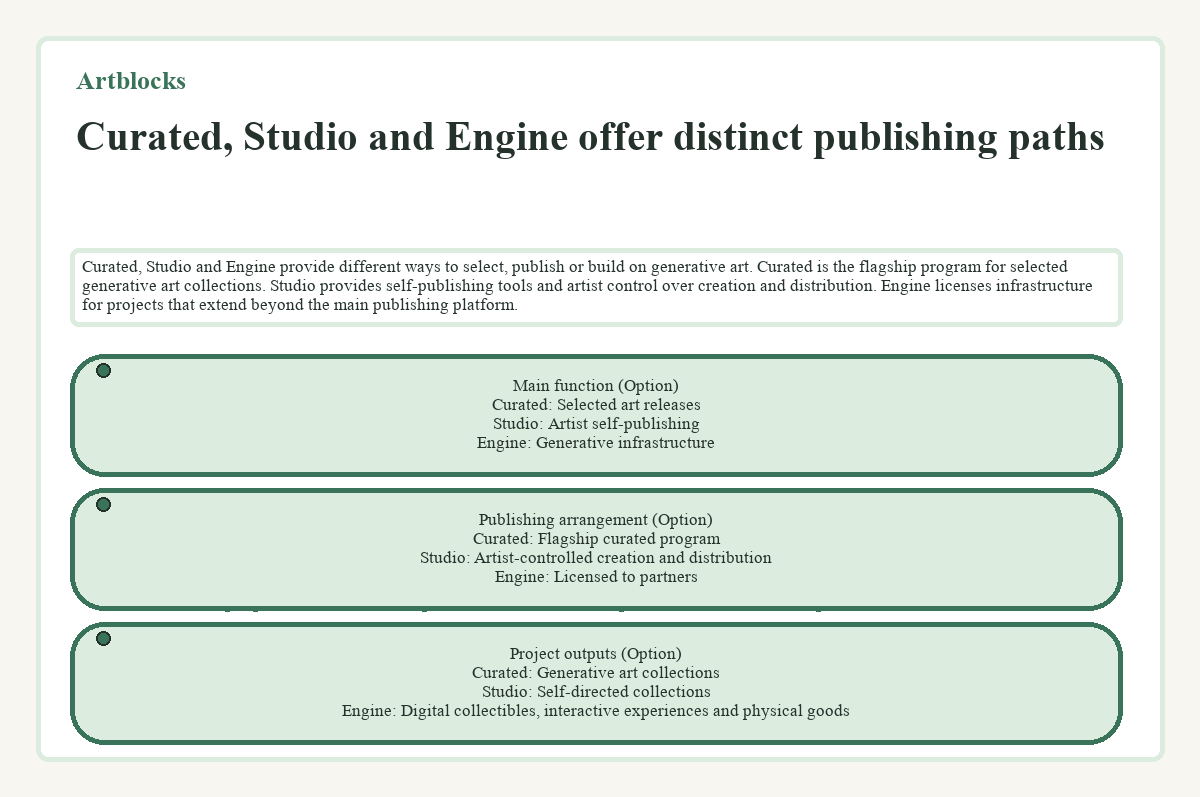
Curated, Studio and Engine provide different ways to select, publish or build on generative art. Curated is the flagship program for selected generative art collections. Studio provides self-publishing tools and artist control over creation and distribution. Engine licenses infrastructure for projects that extend beyond the main publishing platform.
| Option | Main function | Publishing arrangement | Project outputs |
|---|---|---|---|
| Curated | Selected art releases | Flagship curated program | Generative art collections |
| Studio | Artist self-publishing | Artist-controlled creation and distribution | Self-directed collections |
| Engine | Generative infrastructure | Licensed to partners | Digital collectibles, interactive experiences and physical goods |
Artists and visual interests provide different routes through the catalog
The catalog supports discovery through artists, collections and aesthetic groupings, allowing the same body of work to answer different kinds of interest. Geometric, painterly and botanical groupings provide visual starting points. Artist listings preserve the connection between a collection and the person who wrote its creative system. Both approaches concern the artwork itself, before any decision about minting.
Cargo by Kim Asendorf appears under Curated, while Rain Blooms by Kazuhiro Tanimoto appears under Studio. Historical works such as Window by Jan Robert Leegte retain the Factory label.
Engine carries generative infrastructure into partner projects
Engine lets partners operate their own generative projects using infrastructure that includes smart contracts, minting tools and artwork rendering. Partners own and control their deployed contracts. Engine V3 contracts use the ERC-721 NFT standard and integrate with a shared minter suite. Applications extend to digital collectibles, interactive experiences and physical goods, with each partner project defining its actual offering.
Engine Flex adds optional support for multiple libraries and external assets while retaining on-chain storage of the artist's script. A Flex project can also use a traditional configuration without those additions. Each project's asset configuration determines whether it needs resources beyond its script. Flex projects on core version v3.2.5 or later can optionally expose PostParams for authorized changes after minting. Artist-defined permissions and locks govern those changes.
Chromie Squiggle and the earlier collection programs
Erick Calderon, known as Snowfro, founded Artblocks in 2020. Chromie Squiggle was its founding collection.
Earlier publishing programs explain labels that remain visible in the catalog. Playground ran from February 2021 to October 2022 and gave previously Curated artists room for separate experimentation. Factory operated from March 2021 to October 2022, supporting different artistic styles and release mechanics. Presents ran from November 2022 to January 2024 as a team-selected program alongside Curated.
Collaborations launched in June 2022 around institutional partnerships. Explorations launched in November 2022 around experimental, community-focused commissions. The catalog retains historical program labels alongside newer publishing paths.
Preservation requires the complete rendering ingredients
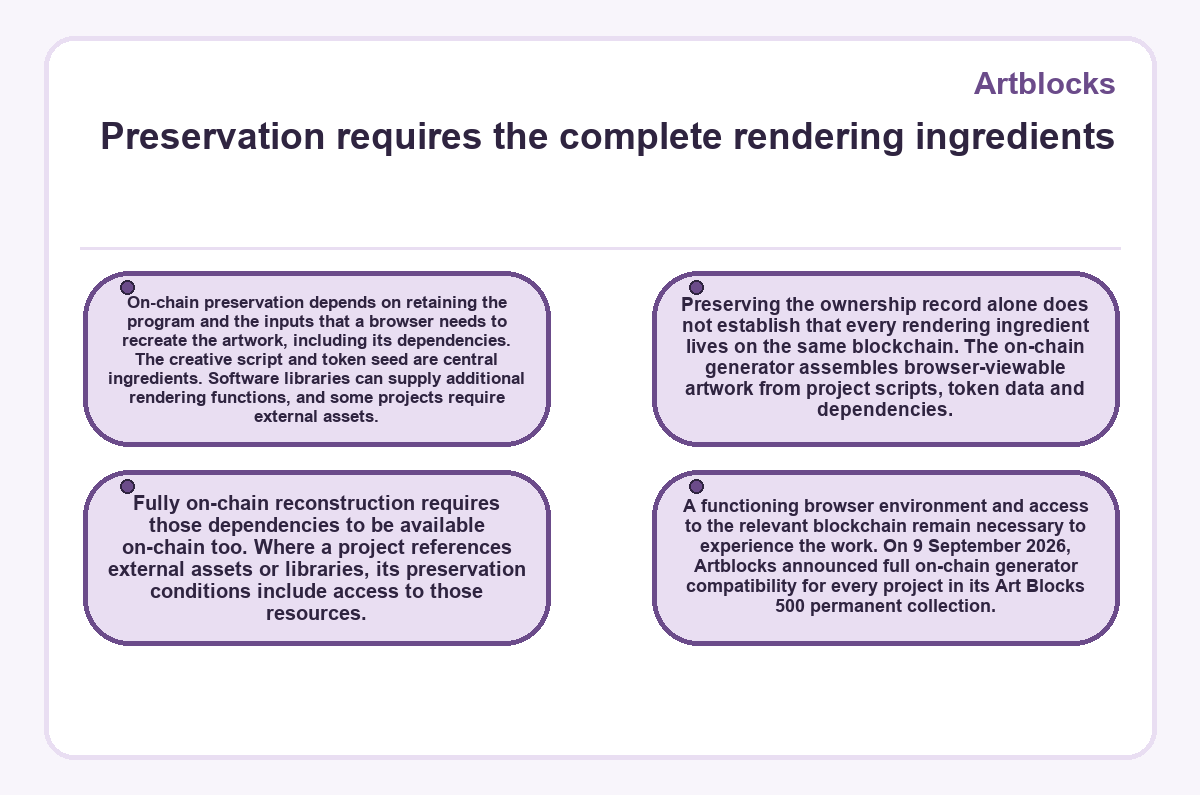
On-chain preservation depends on retaining the program and the inputs that a browser needs to recreate the artwork, including its dependencies. The creative script and token seed are central ingredients. Software libraries can supply additional rendering functions, and some projects require external assets. Preserving the ownership record alone does not establish that every rendering ingredient lives on the same blockchain.
The on-chain generator assembles browser-viewable artwork from project scripts, token data and dependencies. Fully on-chain reconstruction requires those dependencies to be available on-chain too. Where a project references external assets or libraries, its preservation conditions include access to those resources. A functioning browser environment and access to the relevant blockchain remain necessary to experience the work.
On 9 September 2026, Artblocks announced full on-chain generator compatibility for every project in its Art Blocks 500 permanent collection.
The gallery and Journal connect the art with its wider setting
Artblocks operates a gallery in Marfa, Texas, where exhibitions and community events bring generative work into a physical setting. The Journal adds artist features, educational articles and exhibition coverage. Artist discussions explain creative choices behind the code, and exhibition coverage places collections within a broader artistic setting.
Release details shape the next collecting decision
A collection's sale method sets how buyers compete for its available supply and what purchase conditions apply to that release. Fixed-price sales use a posted amount; ranked auctions allocate works through competing bids. Some releases restrict access through an allowlist or a required artwork holding. A publishing label alone does not establish eligibility or promise an available mint.
For an ETH-priced release on Ethereum, the wallet must cover both the artwork price and network transaction fees. Network conditions affect the gas cost separately from the collection's price. During a first-come fixed-price release, a submitted transaction must confirm before the edition sells out. After a release sells out, any available resale offer concerns an existing token. The collecting decision then shifts to that specific token and the terms of its resale.
Artblocks FAQ
Does purchasing an NFT include rights to the artist's algorithm?
Token ownership does not by itself grant rights to the artist's underlying algorithm. The collection's license determines the permitted uses associated with the work and can apply to subsequent owners. The token's ownership record and permission to reproduce or commercialize the artwork are separate matters. Any such use must fit the rights that the applicable license grants.
Which programming language do artists use for the generative scripts?
Artists write project scripts in JavaScript for a browser-based rendering environment. The script uses token data and any configured libraries to produce the artwork. Supported library choices and asset handling depend on the project's configuration. Collecting an NFT does not require writing the script; creating the generative system is the artist's task.
When does a PostParam stop accepting changes?
A PostParam becomes unchangeable after its configured lock date, when the artist has assigned one. Before that date, only users with the configured editing authority can change it. The artist configures the lock date for that parameter at the project level, so it applies across the project's tokens. Other parameters follow their own settings.
Can I save artists and artworks for later?
An account lets you save artists and artworks as you browse the platform. This provides a way to return to work that interests you without minting it. Saving an item does not establish ownership of its NFT.
Are network fees returned when an Ethereum mint fails?
Gas fees that a failed Ethereum transaction has already consumed are not refunded. These fees are separate from the artwork's purchase price. A sent transaction can therefore incur gas even when it does not produce an NFT.
Is every Artblocks edition the same size?
Each project sets its own maximum number of mintable works. The creator designates the edition size, so a count attached to one collection does not establish a platform-wide limit. The project's stated supply limits new issuance from that collection; it does not describe how many existing tokens their owners might offer for resale.